
Criminal Court Records in Pike County
A criminal court record is the case file a court clerk creates when a criminal case is opened against a named defendant. It is not a single page. It is the running collection of charging papers, plea entries, motions, bond orders, hearing notices, trial minutes, the judgment, and the sentence. In Pike County the clerk of the court that hears the case keeps that file, accounts for the costs and fines tied to it, and produces certified copies on request. The record is the official memory of what the State charged, what the defendant answered, and how the case ended.
Several Pike County courts hear criminal matters, and the level of the offense decides where the file lives. Misdemeanors and DUI cases are heard in Justice Court and in the McComb and Summit Municipal Courts. Felonies are tried in Circuit Court, the general trial court for the Fourteenth Circuit District that covers Lincoln, Pike, and Walthall Counties. County Court shares criminal jurisdiction with Justice Court and can also handle certain noncapital felony cases that Circuit Court transfers to it.
Because the venue depends on the charge, the same person can have files in more than one Pike County court. A reader tracing one defendant may need to check the felony record at the Circuit Clerk and a separate misdemeanor or traffic file at Justice Court or a city court.
How to Search Pike County Criminal Court Records
The main online route for Circuit Court case files is the Pike County Circuit Court Link, a subscription service run through Delta Computer Systems and reached from the county's own Circuit Court case information page. It carries case data back to 2000, with scanned documents available from November 2005 forward. A subscription costs $30 per month or $330 per year, and an account is required before you can open a case. Statewide cases also move through Mississippi Electronic Courts, the judiciary's e-filing and viewing system.
- Open the Circuit Court Link from the county case information page and sign in to a subscription account.
- Search by defendant name or by case number, using the year-prefixed format such as 07-CV-1234.
- Narrow the results by court, case type, and filed or disposition date range.
- Open the case to read the docket entries, the disposition, and any scanned filings.
- Request a certified copy from the Circuit Clerk when an official, court-accepted copy is needed.
For misdemeanor and city cases, contact the court that held the matter rather than the Circuit portal. When a record is not online, the universal fallback is the Pike County Information Request Form, which carries a $5 research fee plus $0.50 per copy. A criminal-history background search across the state is a separate process from reading one county case file.
Stages of a Pike County Criminal Case
A criminal case moves through set stages, and each one leaves a mark in the file. Reading those entries in order shows where a case stands and how it was resolved. The record may also show bond changes, continuances, and substitutions of counsel between the major steps.
Case flow: Charges Filed › Arraignment › Pretrial / Motions › Plea or Trial › Disposition › Sentencing
| Stage | What Happens |
|---|---|
| Charges Filed | The case opens through an affidavit, citation, information, or grand-jury indictment, depending on the offense level. |
| Arraignment | The defendant first appears, the charges are read, and a plea of guilty or not guilty is entered. |
| Pretrial / Motions | Lawyers file motions, exchange evidence, argue bond, and ask for hearings or continuances before trial. |
| Plea or Trial | The case ends in a negotiated plea or proceeds to a bench or jury trial for a verdict. |
| Sentencing | After a guilty plea or conviction, the judge imposes the sentence, fines, restitution, or probation. |
In a city case the path is shorter. McComb Municipal Court holds arraignments on Monday and Friday and trials on Wednesday, and the McComb materials explain that a guilty plea leads straight to sentencing while a not-guilty plea sets a new trial date.
The District Attorney's Role in Pike County
Felony charges in Pike County are prosecuted by the District Attorney for the Fourteenth Judicial District, which serves Lincoln, Pike, and Walthall Counties from offices in Magnolia and Brookhaven. The office decides what to charge, presents cases to the grand jury, negotiates pleas, and tries felonies in Circuit Court. Its phone line for the Pike and Walthall office is 601-783-6677. The case file reflects the prosecutor's choices at every turn, from the wording of the indictment to a motion to reduce or dismiss a count.
The Fourteenth Judicial District is described on the official District Attorney website, which lists the office divisions that touch criminal records.
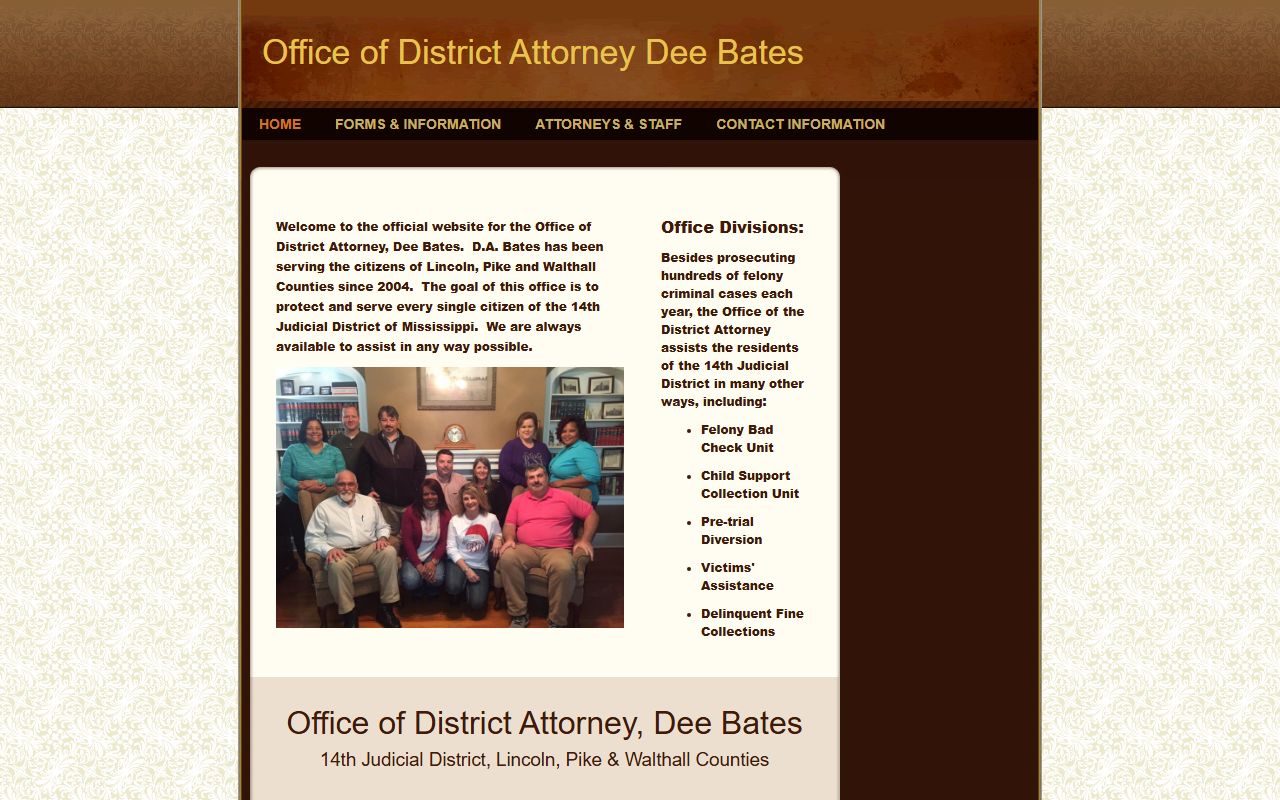
The homepage points readers to the felony, diversion, and victim-assistance functions that shape a Pike County criminal file. The office runs more than felony trials. Its posted divisions include a Felony Bad Check Unit, a Child Support Collection Unit, Pre-trial Diversion, Victims' Assistance, and Delinquent Fine Collections. Each can generate or change entries in a case file, such as a diversion agreement that holds a prosecution open or a collections action on unpaid court debt.
You can see how the office is staffed on the District Attorney staff page, which names the assistant district attorneys, investigators, victim-assistance coordinators, and the grand jury and pretrial coordinators.
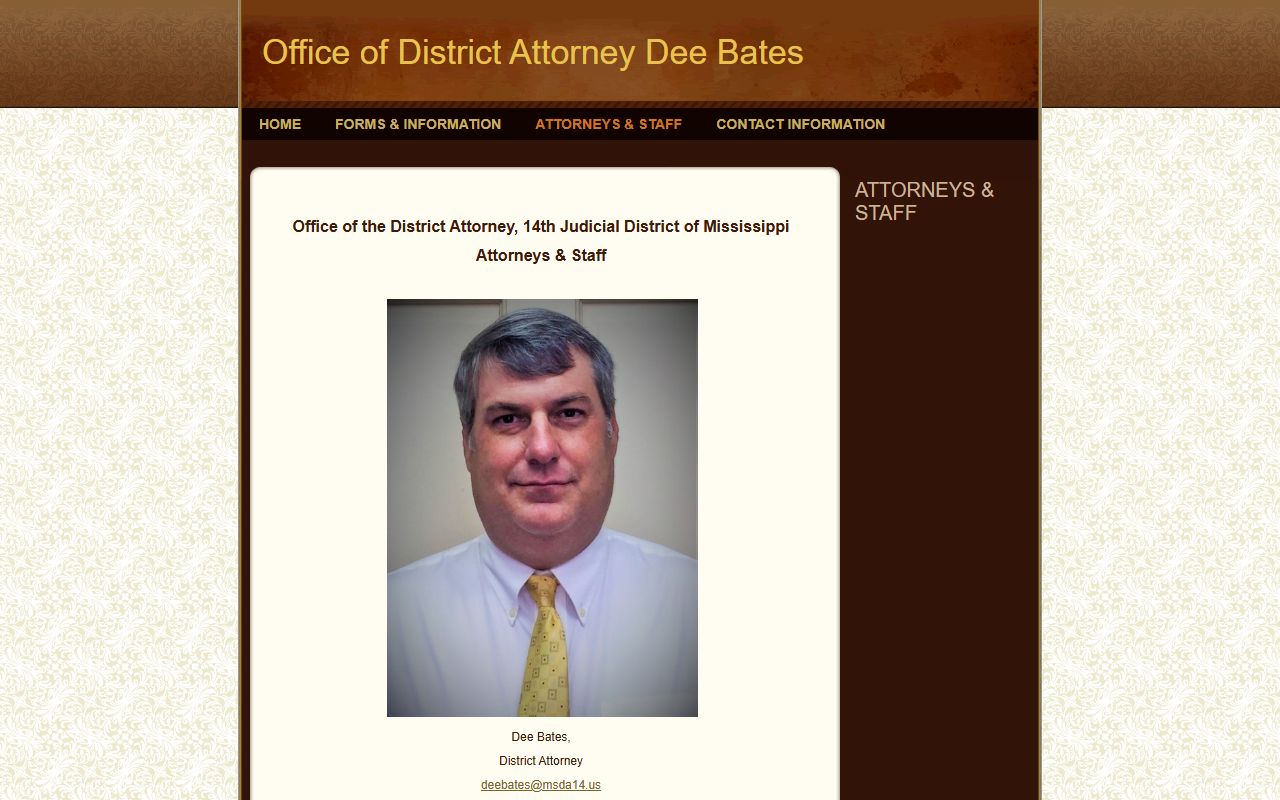
That staffing matters for records because a victim-assistance coordinator or a pretrial intervention coordinator is often the person who can explain a hearing date or a diversion status that the public docket only hints at. The county also keeps its own District Attorney contact page, which lists local office details.
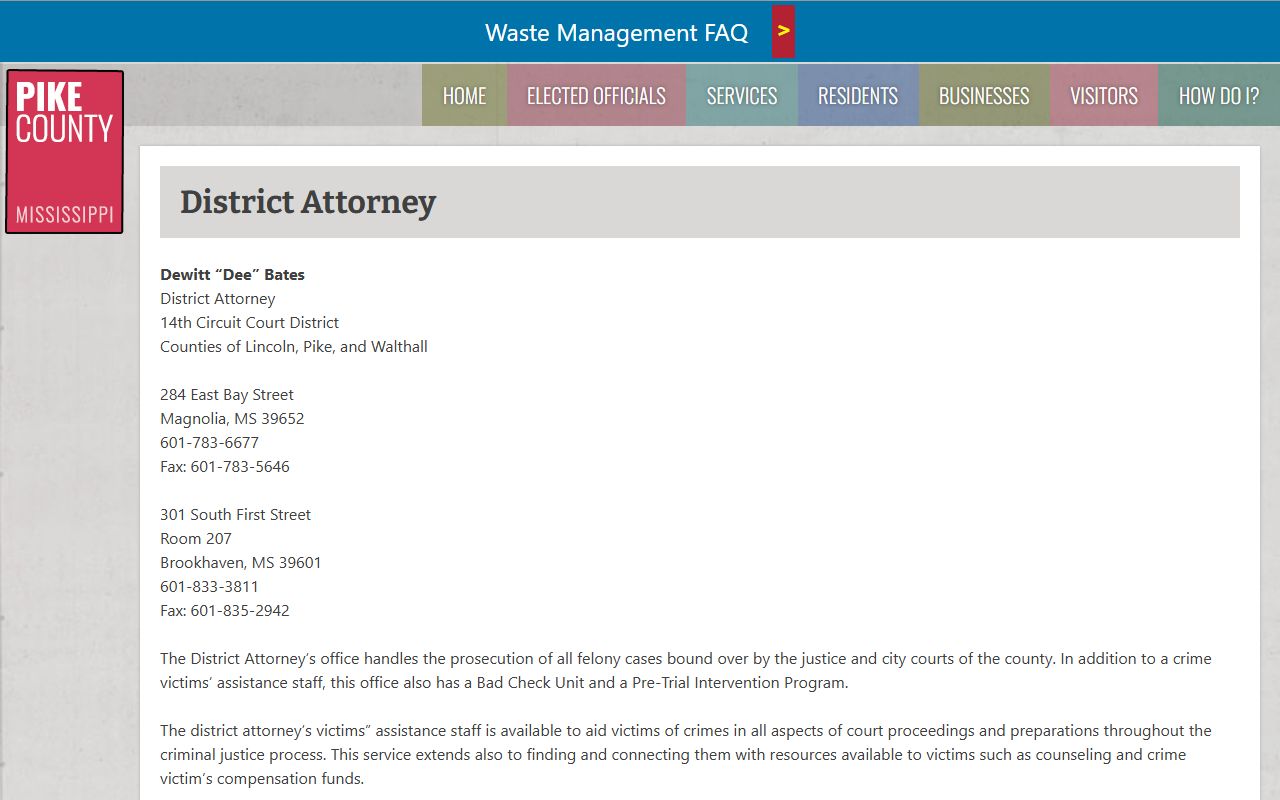
Treat the named officials as subject to change between elections and office transitions, and confirm the current prosecutor through the office directly when it matters for a filing.
What a Pike County Criminal Court Record Shows
The fields in a Pike County criminal file follow the same general shape across courts, even when the docket style differs. The Circuit Court Link exposes the public search keys, and the case file itself fills in the detail behind them. The table below walks through the core fields a criminal record returns and what each one means.
| Field | What It Shows |
|---|---|
| Case Number | The unique court identifier, often in a year-prefixed form such as 07-CV-1234. |
| Court | Whether the case sits in Circuit, County, Justice, or a Municipal Court. |
| Defendant | The person charged, listed as the styled defendant in the case caption. |
| Charges | The criminal counts and the statute or ordinance each count is based on. |
| Filed Date | The date the affidavit, information, or indictment was filed. |
| Plea | The defendant's answer to each charge, such as guilty, not guilty, or nolo contendere. |
| Docket Entries | The dated list of motions, hearings, orders, bond actions, and continuances. |
| Disposition | The outcome of each charge and the final disposition date. |
| Sentence | The punishment, plus any probation, restitution, fines, or court costs. |
Some fields are deliberately absent. Social Security numbers, financial account data, names of minors, medical or mental-health details, and any sealed or expunged matter may be redacted or withheld. A page closely focused on the counts themselves lives in the Pike County arrest records and court charges guide.
Reading Pike County Dispositions and Sentences
The disposition is the line that tells you how a case or a single charge ended. A few terms come up again and again, and knowing them keeps a record from being misread. A dismissal and an acquittal both leave a defendant without a conviction, but they reach that result in different ways.
- Disposition
- The final or current outcome of a case or a charge.
- Conviction
- A finding or plea that establishes guilt on a charge.
- Nolo contendere
- A no-contest plea that accepts the penalty without admitting guilt.
- Dismissed
- The charge was dropped by the court or the prosecutor and not decided on the merits.
- Probation
- Court-ordered supervision in the community instead of, or after, jail or prison time.
- Capias
- A custody order, often issued after a defendant fails to appear.
A sentence in the record may combine several parts. It can list a term of incarceration, a suspended portion, probation, a fine, court costs, and restitution to a victim, all in one order. Reading the full sentencing entry matters, because a long stated term may be largely suspended.
Charges vs. Convictions
Being charged is not the same as being convicted. A criminal court record often shows charges that were later dropped, dismissed, reduced, or that ended in an acquittal at trial. The accusation and the verdict are separate facts, and a careful reader weighs the disposition, not just the original count.
| Charge | Conviction | |
|---|---|---|
| Stage | Accusation that opens the case | Verdict or plea that ends it |
| Decided by | Prosecutor and grand jury or affidavit | Judge or jury, or a guilty plea |
| Burden of proof | Probable cause | Beyond a reasonable doubt |
| Public record | Yes | Yes |
| Lasting effect | May be dismissed or dropped | Carries the sentence and a criminal history |
This distinction is why the disposition field carries so much weight. A file that lists a serious charge with a dismissal entry is a very different record from one that lists the same charge with a conviction and a sentence.
Drug Court and Diversion in the Fourteenth District
Not every felony case ends in a standard sentence. The Fourteenth Circuit Drug Court is a problem-solving court that uses treatment, supervision, drug testing, and regular court review as an alternative for eligible participants. The Mississippi judiciary reported that the program marked its 25th year at an event held at the Pike County Multi-Purpose Complex, with the district attorney speaking to participants and their families. Because the Fourteenth Circuit covers Lincoln, Pike, and Walthall, the drug court directly touches Pike felony cases.
The District Attorney's office also runs a Pre-trial Diversion program. When a case is diverted, the prosecution is held open while the defendant meets conditions, and the docket may show the case in a pending or supervised status rather than a quick guilty or not-guilty outcome.
Specialty-court files can read differently from ordinary cases because progress reviews, phase changes, and completion or removal all become docket entries. The official sources did not publish a full eligibility checklist, phase length, or fee schedule, so those local program rules should be confirmed with the court.
Sealed vs. Expunged Records
Some Pike County criminal records are removed from public view. Sealing and expunction are different remedies with different effects, and Mississippi treats them under separate rules. Expunction in Mississippi runs through Miss. Code Ann. § 99-19-71, which sets a petition process with eligibility limits tied to the charge, the disposition, and the time that has passed.
| Sealed | Expunged | |
|---|---|---|
| Visibility | Hidden from public search | Treated as though it never happened |
| Law enforcement | Limited access remains | Very limited, narrow exceptions only |
| How it happens | Court order or statute | Petition granted under § 99-19-71 |
| Where to start | Court that held the case | Clerk of the convicting court |
An expunction normally begins in the court where the case exists. A Justice Court misdemeanor starts at Pike County Justice Court, a felony starts with the Circuit Clerk, and a city conviction starts with McComb or Summit Municipal Court. The petitioner usually needs the case number, charge, disposition, and proof that any waiting period, fine, cost, or supervision condition is satisfied. The official Pike sources did not publish an expunction fee schedule, so confirm cost with the clerk of the court that handled the case.
Public Access to Criminal Court Records
Mississippi treats most court records as open. The Public Records Act says public records are generally available for inspection unless a statute makes them exempt, and the act does not require that every file be free or online. It requires that public bodies give access, or a written explanation, through reasonable channels. For Pike County, those channels are the Circuit Clerk, the Justice Court clerk, the municipal court clerks, and the records-request fallback when a file is not posted.
Key Statutes:
Mississippi Code § 25-61-1 - public records are open for inspection unless a statute exempts them.
Mississippi Code § 25-61-5 - public bodies must provide access or a written explanation within the required time.
Mississippi Code § 9-1-38 - certain internal judicial work-product records are exempt from disclosure.
The Mississippi Ethics Commission publishes the state's public-records policy, and Miss. Code Ann. § 25-61-7 lets a public body charge the actual cost of searching, copying, and mailing records. A reader who wants the full picture of every Pike court file can start with the broader Pike County court records overview.
Indigent Defense in Pike County Cases
A criminal file also reflects who represented the defendant. When a defendant cannot afford a lawyer, the court appoints counsel, and that appointment becomes part of the record. Mississippi maintains statewide resources for finding appointed defense, even though no separate Pike-specific public-defender office page was located in the official sources.
The Mississippi Office of State Public Defender directory is the state's tool for locating public-defender contacts.
For a Pike County case, appointment information is best requested from the court handling the matter or through the state directory. Naming a specific appointed attorney from an unofficial listing is not reliable, since assignments change case by case.
Federal Criminal Cases for Pike County
Federal charges are not part of the Pike County court system. A federal crime committed in the county is handled in the U.S. District Court for the Southern District of Mississippi, and Pike County sits in that court's Western Division at Natchez. Federal records move through PACER and CM/ECF, not the Circuit Clerk, and the two systems do not share files.
Federal prosecutions are brought by the U.S. Attorney's Office for the Southern District of Mississippi, the federal counterpart to the local District Attorney.
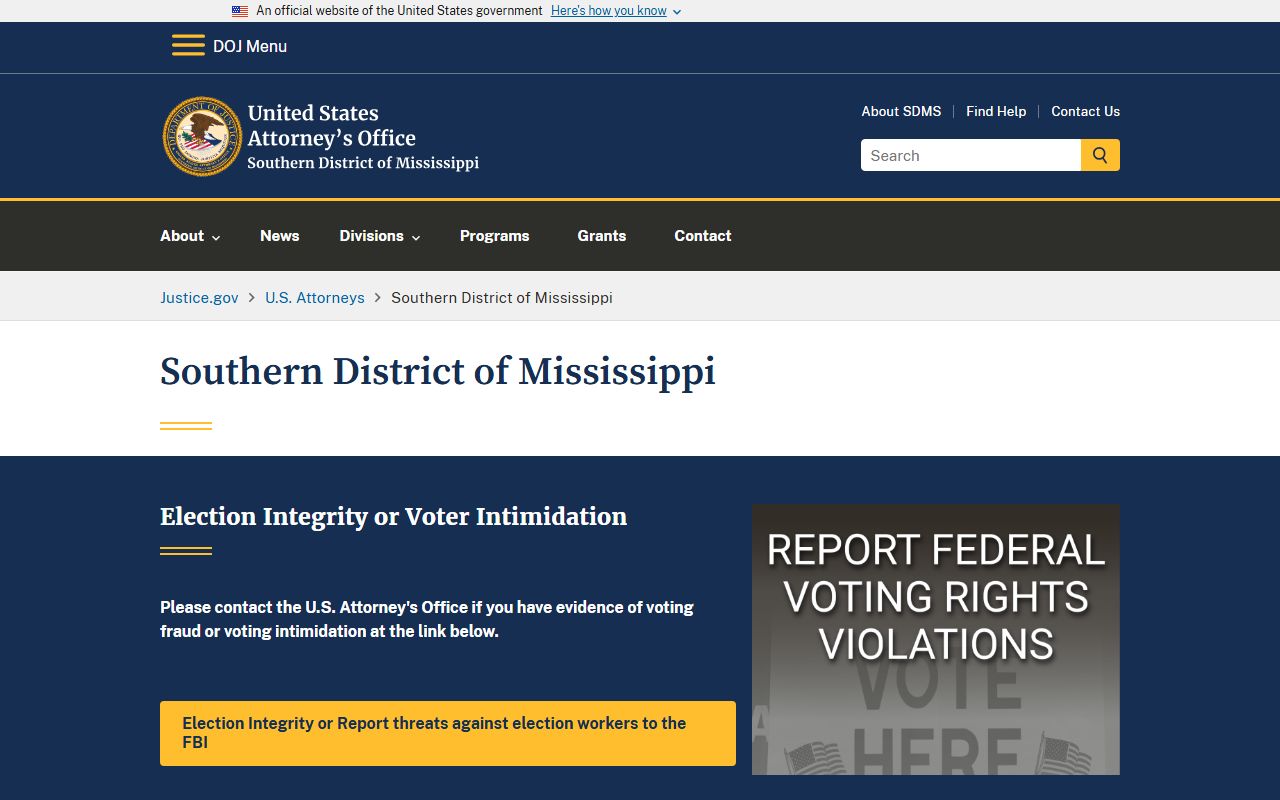
A Pike resident's state felony, misdemeanor, or traffic case will not normally appear in federal court. Federal records cover federal crimes, civil-rights matters, and other cases within federal jurisdiction, and federal custody routes through the U.S. Marshals Service and the Bureau of Prisons rather than the Pike County Detention Center.
Restricted Criminal Court Records in Pike County
Some criminal-related records are closed even though most case files are public. Youth Court matters are the clearest example. Pike County Court includes Youth Court, and Mississippi guidance treats proceedings involving children under 18 as closed to the public, with the records sealed under the youth-court confidentiality rules in Title 43, Chapter 21 of the Mississippi Code.
- Youth Court and juvenile cases, which are generally sealed and limited to parties and authorized agencies.
- Sealed or expunged criminal cases, which may show only limited metadata or none at all.
- Personal identifiers such as Social Security numbers, dates of birth, and minor-identifying details.
- Medical and mental-health information contained within a case file.
Important: This site is a private resource and is not a consumer reporting agency under the Fair Credit Reporting Act, so its records cannot be used for credit, employment, tenant, or insurance decisions.
When a record is restricted, the right step is to ask the court that holds it whether you qualify for access, rather than assuming a missing file means the case never existed.